

JustiCore exists at the intersection of evidence, ethics, and real-world justice.

About Us
-
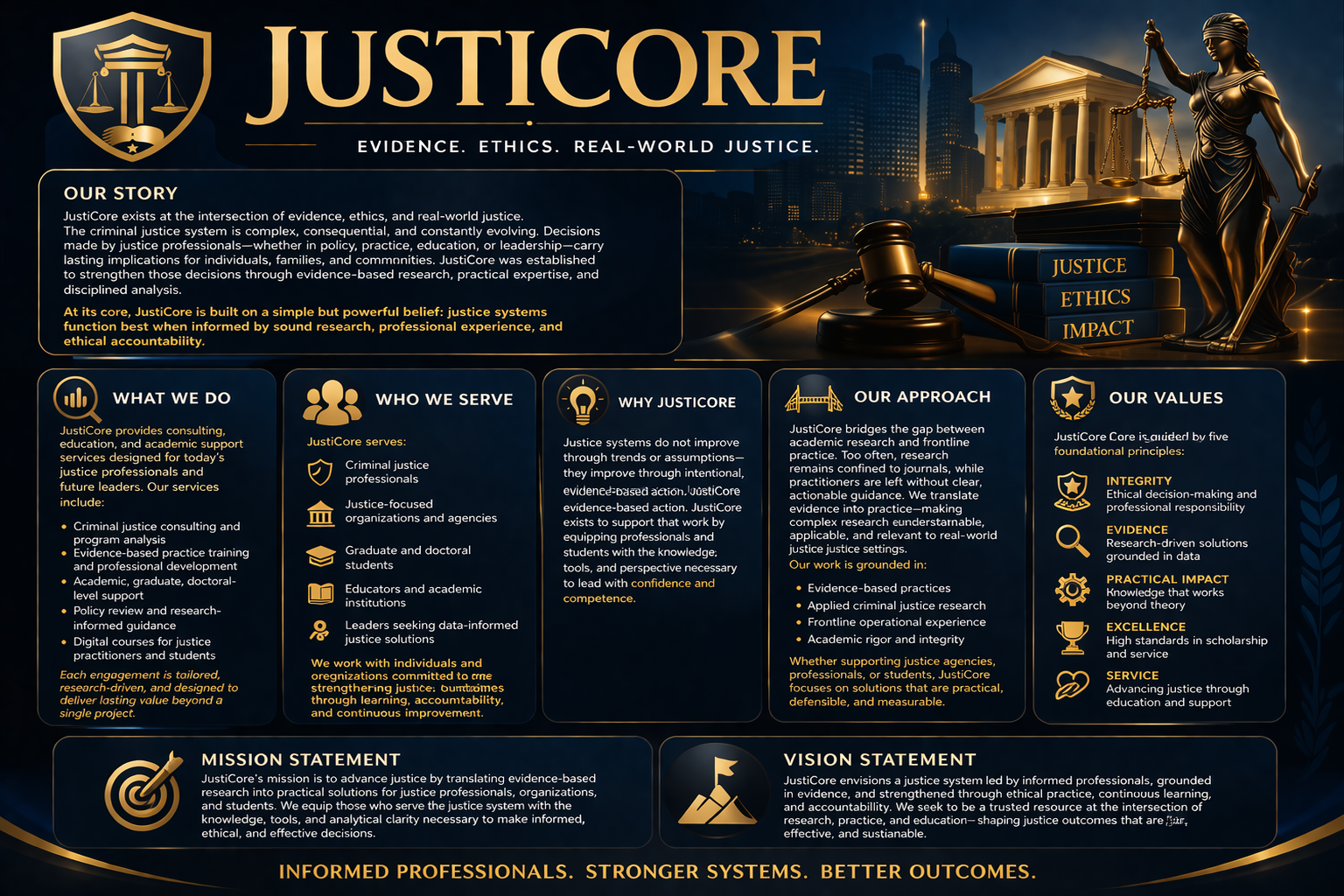
JustiCore exists at the intersection of evidence, ethics, and real-world justice.
The criminal justice system is complex, consequential, and constantly evolving. Decisions made by justice professionals—whether in policy, practice, education, or leadership—carry lasting implications for individuals, families, and communities. JustiCore was established to strengthen those decisions through evidence-based research, practical expertise, and disciplined analysis.
At its core, JustiCore is built on a simple but powerful belief: justice systems function best when informed by sound research, professional experience, and ethical accountability.
-
JustiCore provides consulting, education, and academic support services designed for today’s justice professionals and future leaders. Our services include:
Criminal justice consulting and program analysis
Evidence-based practice training and professional development
Academic, graduate, doctoral-level support
Policy review and research-informed guidance
Digital courses for justice practitioners and students
Each engagement is tailored, research-driven, and designed to deliver lasting value beyond a single project.
-
JustiCore serves:
• Criminal-Justice-Professionals
• Justice-focused organizations and agencies
• Graduate and doctoral students
• Educators and academic institutions
• Leaders seeking data-informed justice solutions
We work with individuals and organizations committed to strengthening justice outcomes through learning, accountability, and continuous improvement.
-
Justice systems do not improve through trends or assumptions—they improve through intentional, evidence-based action. JustiCore exists to support that work by equipping professionals and students with the knowledge, tools, and perspective necessary to lead with confidence and competence.
-
JustiCore bridges the gap between academic research and frontline practice. Too often, research remains confined to journals, while practitioners are left without clear, actionable guidance. We translate evidence into practice—making complex research understandable, applicable, and relevant to real-world justice settings.
Our work is grounded in:
• Evidence-based practices
• Applied criminal justice research
• Frontline operational experience
• Academic rigor and integrity
Whether supporting justice agencies, professionals, or students, JustiCore focuses on solutions that are practical, defensible, and measurable.
-
JustiCore is guided by five foundational principles:
• Integrity – Ethical decision-making and professional responsibility
• Evidence – Research-driven solutions grounded in data
• Practical Impact – Knowledge that works beyond theory
• Excellence —High standards in scholarship and service
• Service – Advancing justice through education and support
These values shape every course, consultation, and collaboration.
-
JustiCore’s mission is to advance justice by translating evidence-based research into practical solutions for justice professionals, organizations, and students. We equip those who serve the justice system with the knowledge, tools, and analytical clarity necessary to make informed, ethical, and effective decisions.
-
JustiCore envisions a justice system led by informed professionals, grounded in evidence, and strengthened through ethical practice, continuous learning, and accountability. We seek to be a trusted resource at the intersection of research, practice, and education—shaping justice outcomes that are fair, effective, and sustainable. Item description

Founder’s Statement
JustiCore was founded from firsthand experience inside the criminal justice system and years of academic study examining how justice policies and practices operate in reality—not just in theory.
Throughout my career, I observed a consistent disconnect between research and practice. Frontline professionals are often expected to implement “best practices” without access to the research behind them, while scholars produce valuable findings that rarely reach the practitioners who need them most. JustiCore was created to close that gap.
My work is shaped by experience across multiple roles within the justice system, combined with advanced academic training in criminal justice and forensic psychology. This dual perspective—both practitioner and scholar—drives everything JustiCore offers. I believe justice professionals deserve resources that are rigorous, realistic, and respectful of the challenges they face daily.
JustiCore is not about quick answers or one-size-fits-all solutions. It is about thoughtful analysis, ethical responsibility, and strengthening justice through evidence. Every service, course, and consultation reflects a commitment to advancing justice with clarity, integrity, and purpose.
Dr. Sevoca Glass Jr —Founder, JustiCore

Meet the Founder
Dr. Sevoca Glass Jr.
Founder | JustiCore Consulting
Sevoca Glass Jr. is a criminal justice scholar-practitioner with extensive experience across federal law enforcement, corrections, behavioral analysis, and higher education. His professional background spans frontline operations and academic leadership, providing a comprehensive perspective on how justice systems function in practice.
Sevoca holds a Bachelor of Science in Criminal Justice, a Master of Arts in Forensic Psychology, a Master of Science in Criminal Justice, and a Doctorate of Philosophy in Criminal Justice from Liberty University. His academic work focuses on evidence-based practices, juvenile justice, family dynamics, and system-level decision-making. As an adjunct instructor, he has taught various criminal justice courses, integrating real-world experience with research-driven instruction.
Through JustiCore, Sevoca brings disciplined analysis, ethical accountability, and practical insight to justice consulting, professional development, and academic support. He is committed to strengthening justice systems through research, education, and service.
Founders Research: Doctoral Scholarship in Criminal Justice
-
At JustiCore Consulting, our work is grounded not only in professional experience across corrections, courts, federal service, and higher education—but also in doctoral-level research designed to advance evidence-based justice.
-
An Analysis of the Relationship Between Family Dynamics and Juvenile Delinquency: A Qualitative Case Study with Probation Officers
-
This doctoral research explores how juvenile probation officers perceive the role of family dynamics in shaping delinquent behavior, rehabilitation outcomes, and long-term youth success. Through qualitative interviews with experienced probation professionals, the study examines how factors such as parental involvement, household structure, supervision practices, trauma exposure, communication patterns, and environmental instability influence juvenile offending and intervention effectiveness. The findings highlight that family systems often serve as either significant protective factors or major criminogenic influences depending on the presence of structure, accountability, and support. This research emphasizes that successful juvenile justice strategies must extend beyond the youth alone and consider the broader family context when designing interventions, supervision models, and rehabilitation frameworks. By integrating practitioner insight with evidence-based analysis, this work contributes to more informed policy development, improved probation strategies, and stronger rehabilitation outcomes for justice-involved youth.
-
Understanding juvenile delinquency requires more than focusing on individual behavior—it demands examining the family systems, environmental pressures, and social dynamics that often shape criminal trajectories. This research provides valuable insight for:
Juvenile Probation Officers
Court Professionals
Correctional Practitioners
Youth Intervention Programs
Policy Leaders
Criminal Justice Educators
-
Family structure and supervision influence delinquency outcomes
Positive family engagement can reduce recidivism risk
Trauma and instability often contribute to youth offending
Probation strategies are strengthened when family dynamics are addressed
Evidence-based juvenile justice must include family-centered considerations
-
At JustiCore Consulting, we believe justice is strongest when practice is informed by evidence. This research reflects our commitment to bridging scholarship, policy, and real-world criminal justice leadership.
Evidence matters. Integrity matters. Justice demands both.